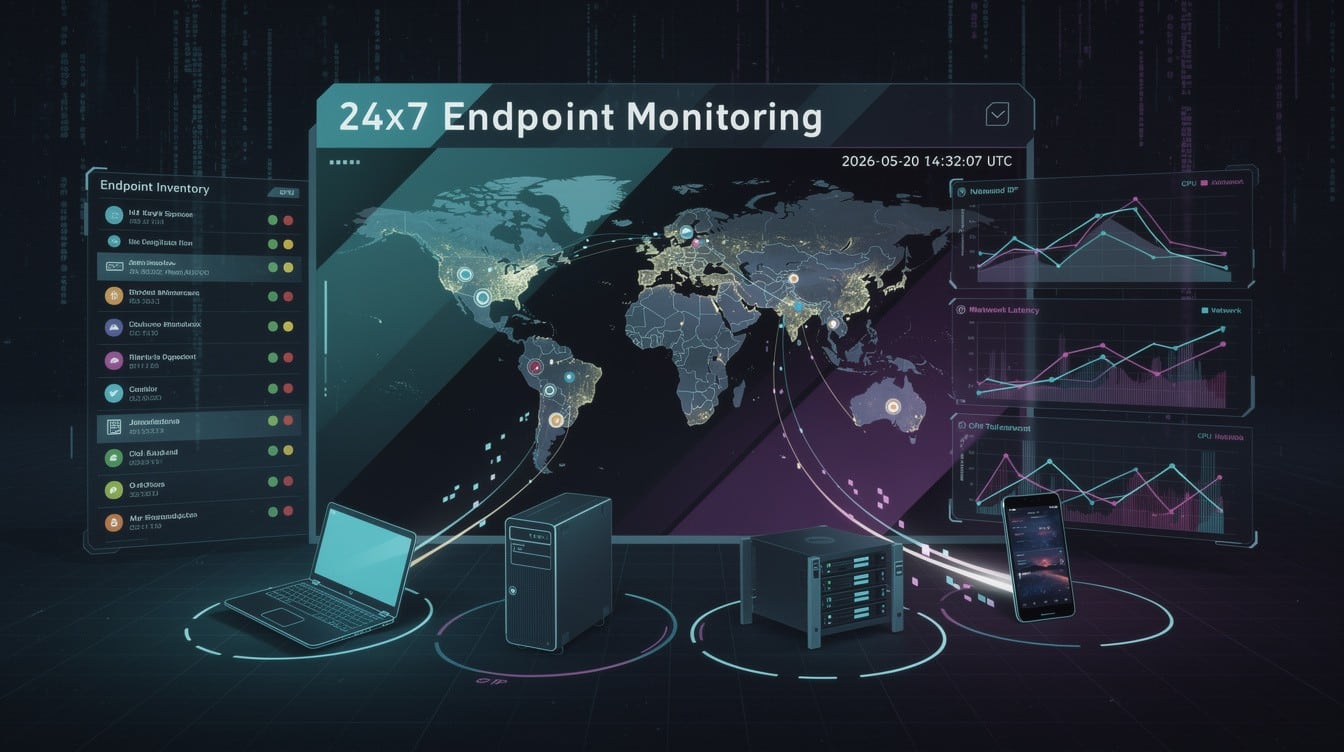
Your business runs on endpoints-laptops, desktops, servers, and mobile devices. Yet most small business owners lack visibility into what’s happening across these critical assets until a breach occurs.
24×7 endpoint monitoring changes that equation. By detecting threats in real time, you stop attackers before they drain resources, compromise data, or trigger costly downtime.
This guide shows you why continuous monitoring matters and how to implement it without disrupting your operations.
What Happens When Threats Go Undetected
Undetected endpoint threats don’t announce themselves. A compromised laptop sits silently on your network for weeks. Malware quietly exfiltrates customer data. Ransomware spreads across shared drives while your team works unaware.
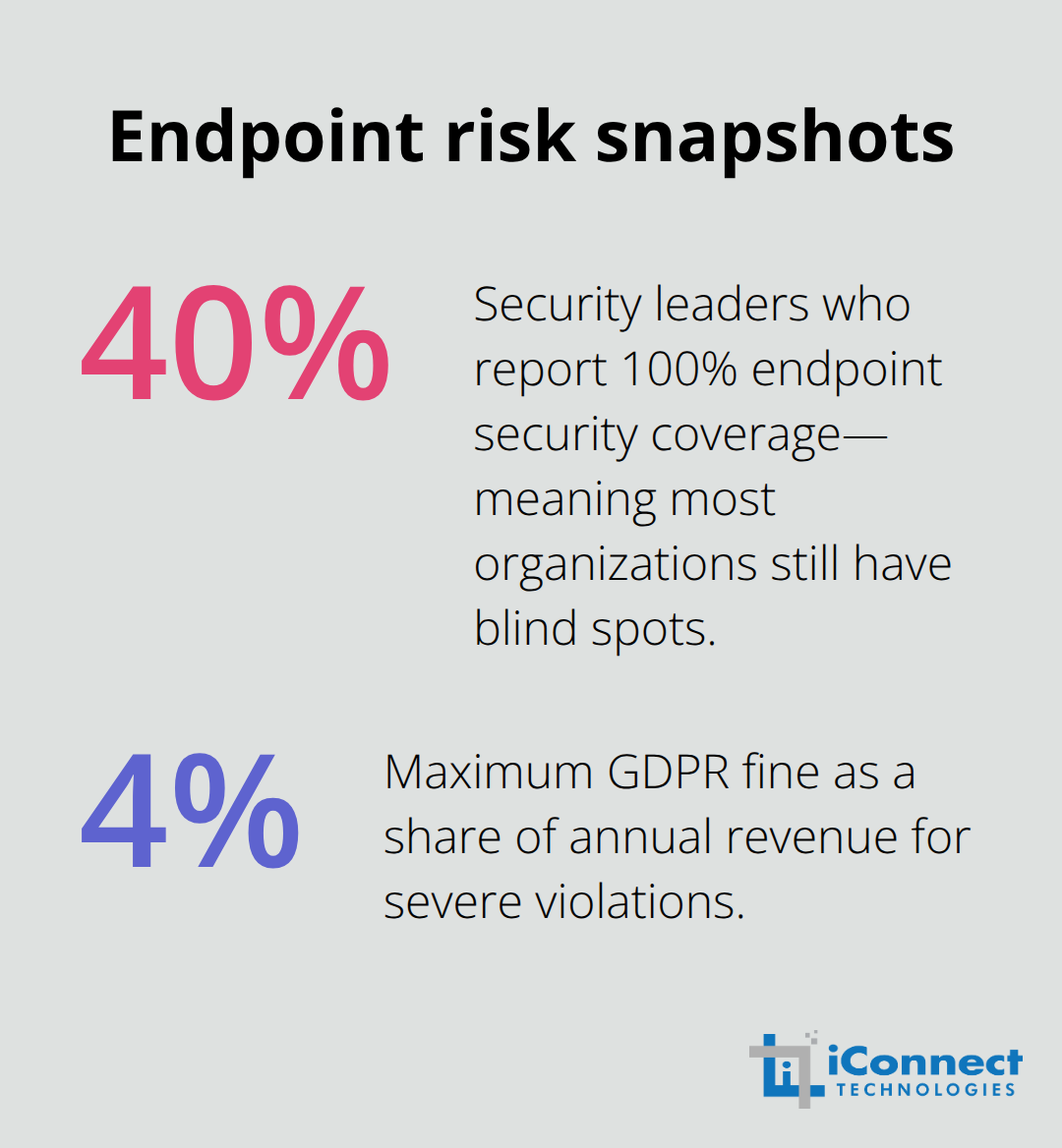
The damage compounds in layers-first the immediate breach, then the discovery costs, then the fallout. According to The State of Cybersecurity: 2025 Trends Report, only 40% of security leaders report 100% endpoint security coverage, meaning the majority of organizations operate with dangerous blind spots. For small businesses without dedicated security staff, this visibility gap becomes catastrophic. You don’t know what you don’t know, and attackers exploit that ignorance ruthlessly.
The Hidden Cost of Delayed Detection
When a breach remains undetected for weeks or months, the financial damage extends far beyond the initial intrusion. Your team cannot contain what they cannot see. A single compromised endpoint can become a launching point for lateral movement across your entire network, infecting servers, cloud storage, and backup systems. The longer the threat persists, the deeper it embeds. If ransomware reaches your backups before you detect it, your recovery options vanish. Companies without a disaster recovery plan fail within a year according to industry data, and those without proper detection mechanisms face exponentially higher failure rates. The cost isn’t just the ransom demand or the data recovery bill-it’s the lost productivity while systems go offline, the customer notifications you must send, and the contracts you lose when clients discover their data was exposed under your watch. A hospital system that suffered ransomware without real-time visibility spent months recovering and faced substantial reputation damage. The breach could have been contained in hours with proper endpoint monitoring.
Compliance Becomes Your Legal Liability
Regulators don’t care about your intentions. They care about your controls. HIPAA, PCI-DSS, and GDPR all require you to detect and respond to threats within specific timeframes. When you lack endpoint visibility, you cannot prove you detected anything quickly. You cannot demonstrate that you contained a breach. You cannot show auditors that you responded proportionally. This documentation failure alone can result in penalties that dwarf the original breach cost. A company facing GDPR violations can incur fines up to 4% of annual revenue. PCI-DSS non-compliance triggers merchant account suspension. HIPAA violations carry penalties between $100 and $50,000 per record exposed. These aren’t theoretical risks for small businesses handling customer payment data or health information-they’re direct threats to your operating license. Endpoint monitoring creates the audit trail that proves you took reasonable precautions and responded appropriately when threats emerged.
Why Your Blind Spots Matter Now
The attack surface has expanded dramatically. Remote work, BYOD policies, and IoT devices mean your endpoints now stretch across public networks, home offices, and multiple locations. You cannot distinguish normal from abnormal behavior without continuous visibility. Traditional antivirus-only approaches fail against modern threats like ransomware and zero-day exploits. Attackers move fast; detection delays measured in weeks translate to complete network compromise. The question isn’t whether threats will target your business-it’s whether you’ll see them in time to stop them. Real-time endpoint monitoring closes this gap and transforms your security posture from reactive to proactive.
How 24×7 Endpoint Monitoring Stops Threats Fast
Real-Time Detection Catches Attacks Before They Spread
The moment a threat lands on your network, the clock starts ticking. Every minute without detection multiplies your exposure.
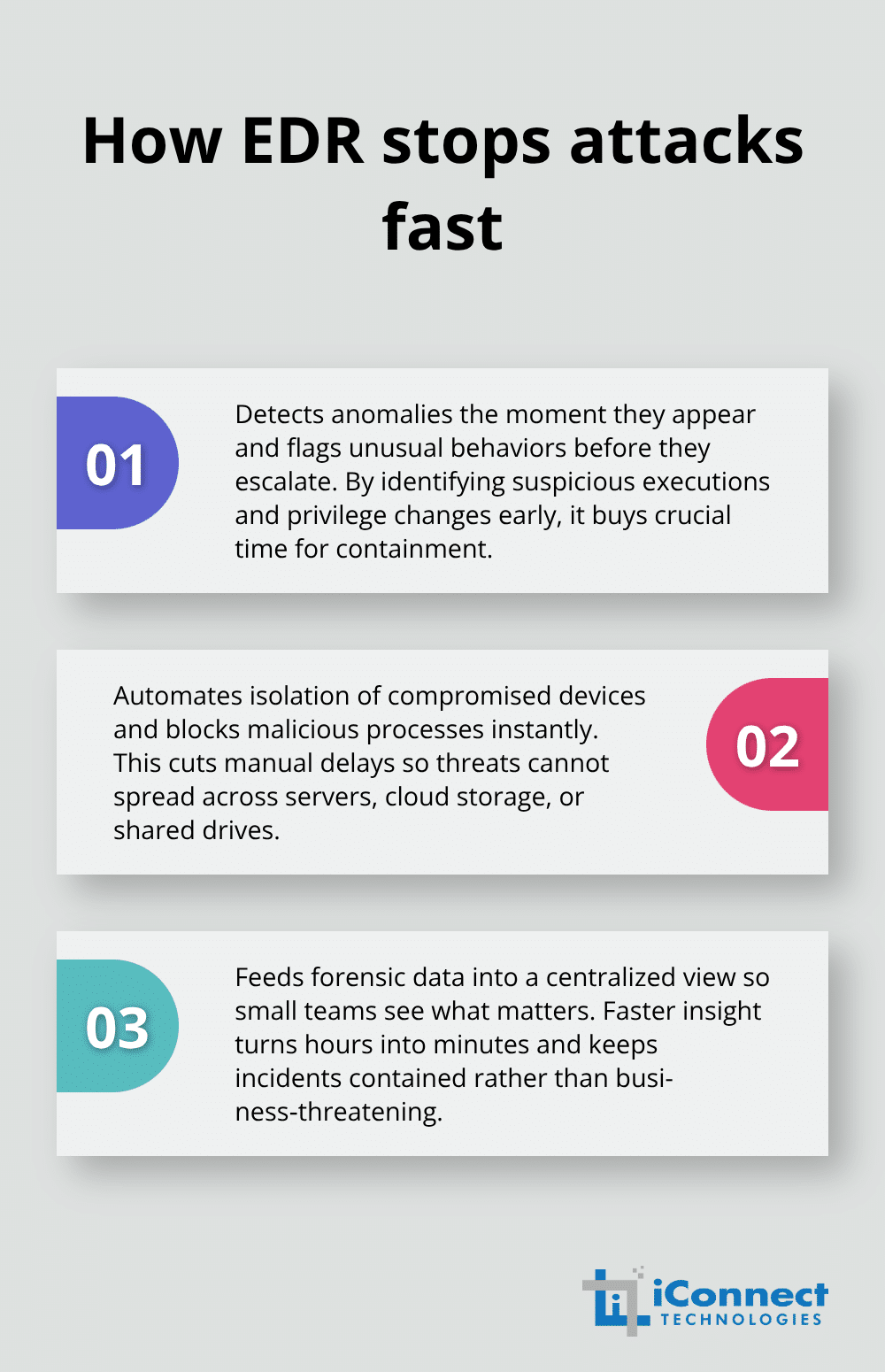
Endpoint Detection and Response, or EDR, automatically detects and defuses potential threats in real time to help security teams identify stealthy attacks. Unlike traditional antivirus, EDR uses machine learning to spot anomalies in real time-unusual file executions, privilege escalation attempts, suspicious network connections, lateral movement across your infrastructure. When malware tries to establish persistence or exfiltrate data, EDR catches it immediately and isolates the compromised device before it spreads to your servers or cloud storage.
This speed matters enormously for small businesses. A hospital system that deployed real-time endpoint monitoring detected and contained a ransomware infection in hours rather than the weeks it would have taken without visibility. That difference meant the difference between a contained incident and a business-threatening shutdown.
Automated Response Eliminates Manual Delays
Your team doesn’t need to manually hunt for threats or wait for security alerts to pile up. Automated response capabilities quarantine infected endpoints, block malicious processes, and notify your IT staff in seconds. The forensic data from each endpoint feeds into a centralized system, giving you complete visibility across laptops in the field, servers in your office, mobile devices your team uses, and any IoT equipment connected to your network. This centralized visibility eliminates the blind spots that attackers exploit.
Practical Implementation Without Overwhelming Your Team
What makes this approach genuinely practical for resource-constrained organizations is that you don’t need a 24/7 security operations center to benefit. Managed service providers handle the monitoring and initial response while your team focuses on business operations. You receive real-time alerts only when action is needed, reducing alert fatigue that causes security teams to miss critical signals. The endpoint data also creates an audit trail that satisfies regulators-you can prove detection times, containment actions, and investigation findings.
When you choose a solution, try prioritizing those offering seamless integration with your existing IT infrastructure, minimal performance impact on endpoints, and customizable alerting so you receive information relevant to your actual risk profile. Scalability matters too; your endpoint monitoring should grow as you add devices without requiring constant reconfiguration or spiraling costs. The investment in real-time endpoint visibility directly reduces your breach costs, downtime expenses, and compliance exposure far more effectively than hoping your traditional antivirus catches something before attackers extract value.
With the right endpoint monitoring foundation in place, your organization gains the visibility needed to detect threats quickly. The next step involves selecting and implementing solutions that align with your specific business needs and existing infrastructure-a process we’ll explore in detail as we move forward.
Getting Endpoint Monitoring Right From Day One
Selecting and deploying endpoint monitoring isn’t a theoretical exercise-it’s a practical decision that determines whether your organization actually sees threats or remains vulnerable. Small business owners often make two critical mistakes: they either choose solutions designed for enterprise complexity that overwhelm their limited IT staff, or they pick cheap tools that create alert fatigue without actionable intelligence. Neither path works. The right approach means finding solutions that deliver genuine visibility without requiring a dedicated security team to operate them.
Assess Your Current Infrastructure and Choose Solutions That Fit
Start with what you already own. Most small businesses run a mix of Windows and Mac endpoints, cloud-based applications through Microsoft 365 or Google Workspace, and some legacy systems they haven’t yet replaced. Your endpoint monitoring solution must integrate seamlessly with this existing infrastructure rather than forcing you to rip and replace everything. Solutions that connect directly to your current IT management tools, backup systems, and firewall reduce deployment friction and accelerate time-to-value. When evaluating options, ask vendors specifically how their platform integrates with your current stack-not theoretical integrations, but documented connectors you can see working in a trial. Flat-rate pricing models eliminate surprise costs as you add devices; avoid per-device pricing that becomes unpredictable as your business grows. A software company prevented six-figure revenue losses through proactive monitoring partly because their solution scaled from 50 to 200 endpoints without requiring contract renegotiation or architecture changes. Scalability isn’t a future concern-it’s a present requirement. Your endpoint monitoring should handle growth without forcing you to switch solutions in two years.
Prioritize Critical Systems and Deploy in Phases
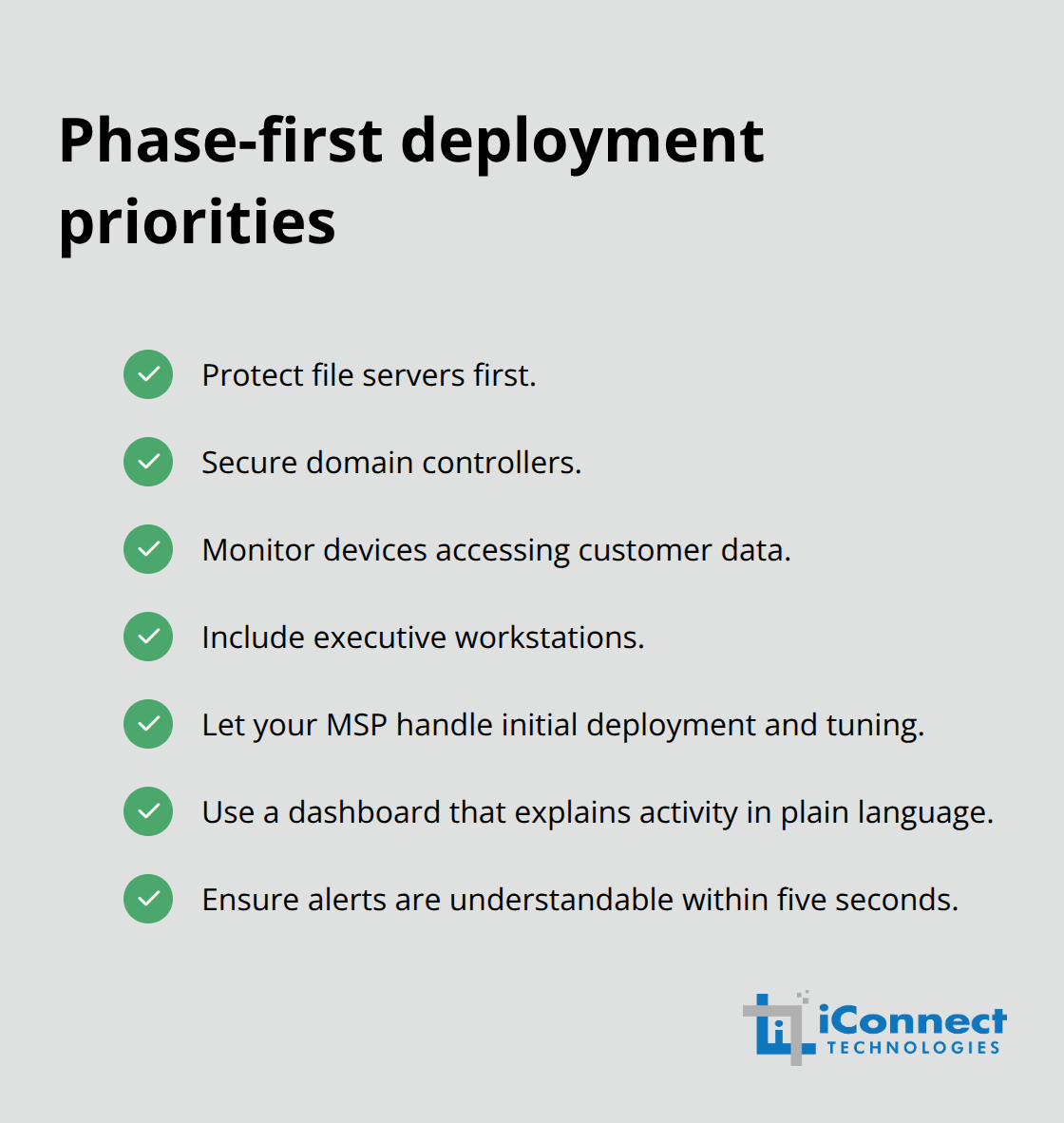
Deployment speed matters more than perfection. Rather than attempting to monitor every device simultaneously, prioritize your critical systems first-file servers, domain controllers, devices accessing customer data, and executive workstations. This phased approach lets your team learn the platform while protecting your most valuable assets immediately. Most managed service providers handle initial deployment and tuning, which eliminates the burden on your IT staff and ensures proper configuration from day one. The monitoring dashboard should show you exactly what’s happening across your endpoints in plain language, not security jargon. If you cannot understand what an alert means within five seconds, the tool will generate noise rather than actionable intelligence.
Configure Alerts and Train Your Team
Configure alerts to match your actual risk profile; you don’t need notifications about every minor system event, only the behaviors that indicate genuine threats. Real-time visibility into endpoint activity means you can distinguish between legitimate administrative activity and suspicious lateral movement, between scheduled updates and unauthorized privilege escalation. Your team needs training not just on the mechanics of the tool but on recognizing what normal looks like in your environment so they spot abnormal behavior confidently.
Establish Response Procedures Before Threats Appear
Endpoint monitoring creates value only when your organization can act on what it sees. Establish clear response procedures before threats appear-who gets notified when a critical alert fires, what containment actions happen automatically versus waiting for human approval, how quickly you escalate to external support if needed. Document these procedures in writing rather than relying on tribal knowledge. If your internal IT capacity is limited, partner with a managed service provider that offers 24/7 monitoring and response; this approach delivers continuous coverage without requiring you to staff a security operations center.
The forensic data from endpoint monitoring feeds directly into incident investigations, showing exactly how an attacker moved through your network and what they accessed. This information proves invaluable for compliance reporting and root-cause analysis. Endpoint monitoring also creates the audit trail that regulators demand-detailed logs of what accessed sensitive data, when systems received patches, and how quickly you responded to anomalies. This documentation transforms endpoint monitoring from a security cost into a compliance asset that reduces your regulatory risk substantially.
Final Thoughts
Endpoint monitoring has shifted from a luxury for large enterprises to a necessity for small business survival. The threats targeting your organization do not pause for budget constraints or limited IT staff, and they exploit the visibility gaps that most small businesses still operate within. 24×7 endpoint monitoring closes those gaps and transforms your security posture from reactive damage control to proactive threat prevention.
Undetected breaches cost exponentially more than prevention, compliance violations threaten your operating license, and downtime erodes customer trust and revenue. Real-time endpoint monitoring addresses all three simultaneously-it detects threats before they cause damage, creates the audit trails regulators demand, and enables rapid containment that minimizes disruption. You do not need a massive security team or enterprise-grade complexity to achieve this protection, as managed service providers handle the continuous monitoring while your team focuses on running your business.
Your next step is straightforward: contact a managed service provider or security vendor to discuss how 24×7 endpoint monitoring fits your specific business needs. Request a trial that covers your critical systems, involve your IT staff in the evaluation, and document your response procedures in writing so your organization can act decisively when threats appear.