
Cyber threats are growing faster than most small businesses can defend against them. A single breach can cost thousands in recovery, damage your reputation, and erode customer trust overnight.
Security-focused managed IT shifts your approach from reactive firefighting to proactive defense. By prioritizing protection at every level-from your network to your endpoints-you build a resilient foundation that keeps your business running safely.
Why Your Business Faces Escalating Security Threats
The Accelerating Threat Environment
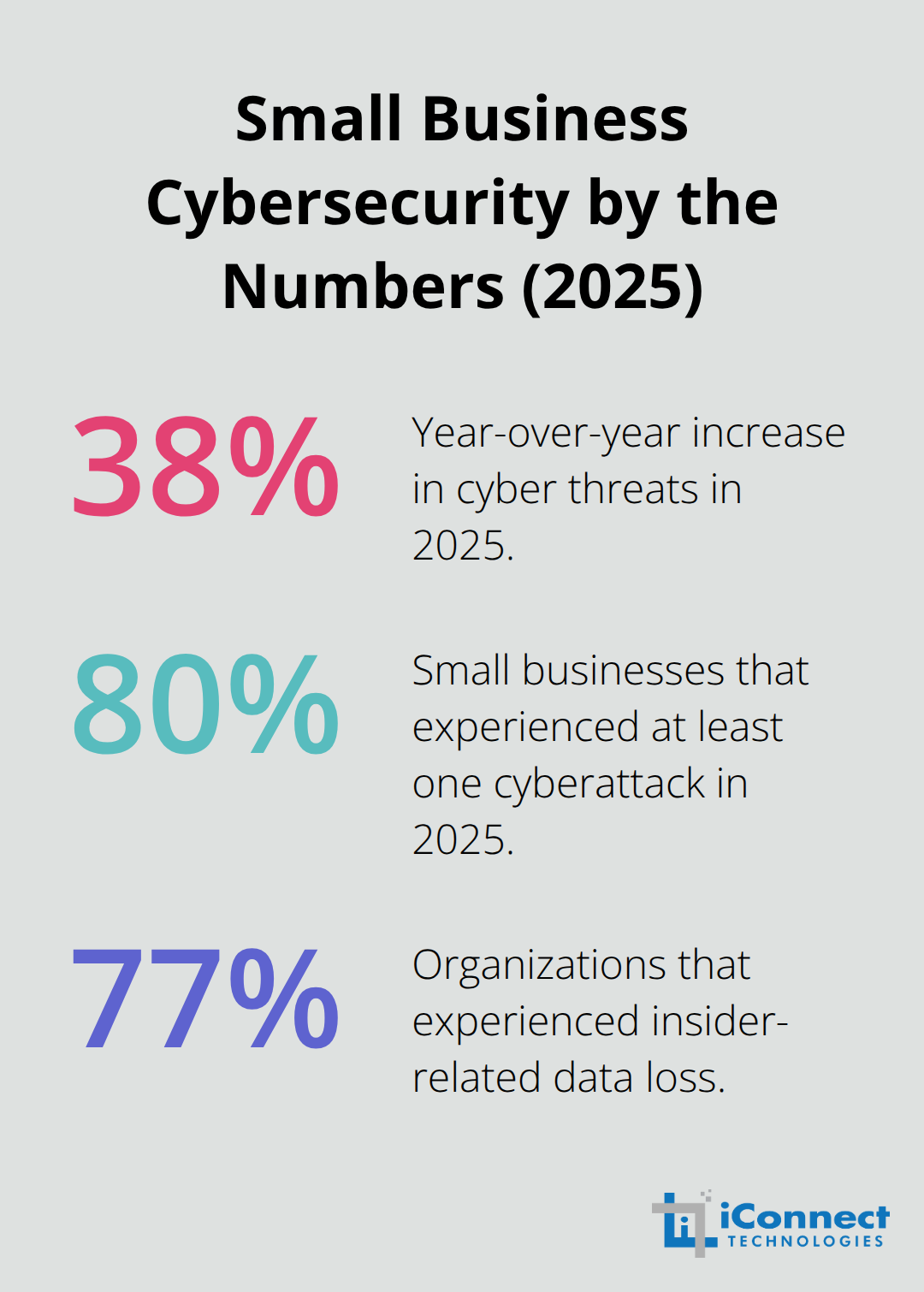
Cyber threats are multiplying faster than most small businesses can defend against them. In 2025, cyber threats increased 38 percent year-over-year, with mid-market and small businesses now squarely in attackers’ crosshairs. This isn’t abstract risk anymore-80% of small businesses experienced at least one cyberattack in 2025. For small business owners, the financial stakes are brutal.
Mid-market breach costs average significant financial exposure, and nearly half of mid-sized firms estimate that just one hour of downtime exceeds one million dollars in losses. A real-world example underscores this danger: Marks & Spencer suffered a breach through a third-party IT supplier, with cleanup costs estimated at over 40 million pounds in lost sales per week. These aren’t outliers; they’re warnings about what happens when security isn’t prioritized from day one.
Regulatory Obligations That Demand Action
Regulatory frameworks add another layer of urgency. GDPR, HIPAA, PCI DSS, SOX, and ISO 27001 create legal obligations to protect data, and violations carry steep penalties that can cripple smaller operations. Compliance isn’t optional-it’s survival. Your customers and partners increasingly demand proof that you take their data seriously, and a single breach destroys that trust irreversibly.
The Hidden Cost of Fragmented Tools
Most small businesses operate with disconnected security tools scattered across vendors. The Ponemon Institute found that organizations deploy an average of 47 cybersecurity solutions, creating blind spots, finger-pointing, and slow incident response when attacks happen. This fragmented approach leaves critical gaps that attackers exploit. When your firewall vendor, endpoint protection provider, and monitoring service don’t communicate, you lose visibility across your entire network and cloud environment. During an incident, this fragmentation means wasted time determining who owns the problem and slower containment. A security-first approach consolidates these tools under one integrated partner who owns the entire outcome, eliminating the delays that turn minutes into hours of exposure. Response speed directly impacts damage-faster detection and isolation mean lower costs and less data loss.
How Customers Judge Your Security Posture
Your reputation is your most valuable asset, and customers judge you partly on how seriously you handle their information. Organizations that demonstrate robust security practices through regular assessments, compliance certifications, and transparent reporting earn customer confidence and partner credibility. Conversely, a publicized breach doesn’t just cost money in recovery; it damages relationships and market position for years. Proactive security services provide the continuous monitoring, threat intelligence, and incident response capabilities needed to catch threats before they become public crises. This proactive stance also simplifies your compliance reporting, turning security investments into competitive advantages that resonate with risk-conscious customers and partners who increasingly require vendor security assessments before engagement.
Moving From Fragmentation to Integration
The path forward requires you to consolidate your defenses and align them with your business goals. This transition-from scattered point solutions to an integrated security strategy-forms the foundation for the core components that actually stop attacks.
What Actually Stops Attacks Before They Reach Your Data
Security-focused managed IT rests on three integrated pillars that work together to detect threats early, block attacks at entry points, and respond faster than attackers expect. Endpoint protection catches malware before it executes on your devices, managed firewalls enforce strict access rules at your network perimeter, and continuous monitoring creates visibility across your entire infrastructure so nothing slips through undetected. These components aren’t optional add-ons; they’re the operational backbone that separates breached businesses from protected ones.
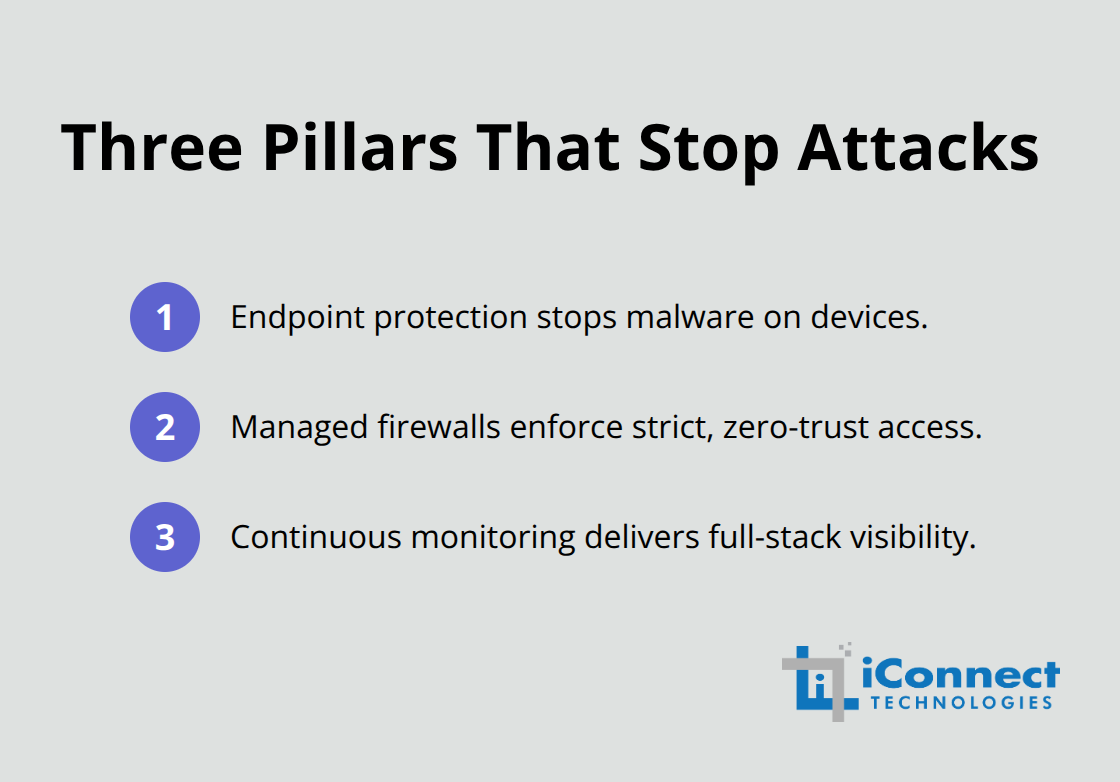
Organizations that deploy integrated endpoint detection and response solutions help reduce dwell time and improve response speed. Faster detection directly reduces breach costs because attackers cause exponentially more damage the longer they operate inside your network. Managed firewalls configured with zero-trust principles block unauthorized access attempts before they reach your systems, and cloud-native firewall platforms provide consistent protection whether your workforce operates on-site, remote, or across multiple cloud environments.
The critical difference between fragmented tool deployments and integrated security is response coordination. When your endpoint protection, firewall, and monitoring platform share threat intelligence automatically, a suspicious file detected on one employee’s laptop instantly triggers firewall rules to block similar threats at the network edge and alerts your SOC team to investigate. This orchestration cuts incident response times dramatically compared to teams manually correlating alerts across disconnected vendors. Mid-market organizations that consolidate their security stack under a single partner typically reduce their mean time to respond from hours to minutes, which directly translates to contained incidents instead of escalated breaches.
Endpoint Protection That Actually Works
Endpoint protection has evolved far beyond antivirus. Modern endpoint detection and response platforms monitor process behavior, registry changes, network connections, and file modifications in real-time, catching sophisticated malware that traditional signatures miss. Ransomware attacks that encrypt your files in minutes require endpoint solutions that detect encryption activity and isolate infected machines automatically before damage spreads.
Insider threats-whether from compromised credentials, malicious users, or careless employees forwarding sensitive data-demand visibility into what files employees access and where data moves. The data shows 77 percent of organizations experienced insider-related data loss, yet only 20 to 34 percent deployed controls like multi-factor authentication and role-based access that could have prevented these incidents. Least-privilege access policies ensure employees can only access specific data their role requires, dramatically reducing the blast radius when accounts are compromised.
Firewalls and Network Boundaries That Actually Enforce Rules
Managed firewalls configured for your specific business needs block unauthorized traffic before it enters your network, but configuration matters enormously. Generic firewall rules fail because they’re too permissive or too restrictive. A security-focused MSP conducts network discovery to understand your legitimate traffic patterns, then builds firewall policies that allow approved applications and block everything else. This default-deny approach stops zero-day exploits and advanced persistent threats that exploit unknown vulnerabilities.
SD-WAN and SASE platforms integrate firewall protection with secure web access and encrypted tunneling for remote workers, ensuring consistent enforcement whether employees connect from home, coffee shops, or client sites. Organizations without proper firewall segmentation see attackers move laterally across their entire network once they breach a single device; proper segmentation contained to departments or data sensitivity levels forces attackers to work harder and increases detection likelihood.
Continuous Monitoring That Detects What Others Miss
Around-the-clock monitoring creates the visibility that stops attacks before they escalate into breaches. Your security operations center (SOC) team-whether internal or outsourced-needs real-time alerts on suspicious activity, failed login attempts, unusual data transfers, and unauthorized access patterns. Threat intelligence feeds update your defenses automatically as new attack signatures emerge, so your systems respond to today’s threats, not yesterday’s. When monitoring platforms correlate events across endpoints, firewalls, and cloud services, they surface attack patterns that isolated tools would miss entirely. This integrated visibility transforms your security posture from reactive incident response into proactive threat hunting, where your team identifies and neutralizes threats before attackers achieve their objectives. The speed of detection directly determines whether an incident remains contained or spirals into a costly breach that damages your reputation and operations.
How to Build Security Into Your Team’s Daily Work
Security technology alone cannot protect your business. Employees are your strongest defense or your biggest vulnerability, depending on how well you equip them with knowledge and accountability. The ITRC’s 2023 Business Impact Report found that 73 percent of small and mid-market businesses experienced a cyberattack or data breach in the past 12 months, yet only 20 to 34 percent of those organizations had deployed basic security practices like multi-factor authentication, strong password policies, and role-based access controls. This gap reveals the core problem: most businesses invest in tools but neglect the human foundation that makes those tools effective.
Train Your Team to Recognize and Report Threats
Phishing remains the most common attack vector because employees lack training. Ransomware spreads through careless credential sharing and unpatched systems because security practices don’t exist in daily workflows. Establish non-negotiable standards that your team follows without exception, starting with mandatory awareness training that teaches employees to recognize phishing attempts, report suspicious activity, and understand why their actions directly impact business survival. Conduct this training at least quarterly and include real phishing simulations that test whether employees actually retain the lessons. Organizations that conduct regular phishing drills see click-through rates drop from 30 to 40 percent down to single digits within six months, proving that consistent reinforcement works.
Your training should also cover data classification so employees understand which information requires encryption, restricted access, or secure deletion. Many breaches start when employees forward customer data to personal email accounts or leave sensitive documents on unsecured cloud storage because they never learned the company’s data handling standards. When your team knows what data matters and why protecting it matters, they make better decisions under pressure.
Scan for Vulnerabilities and Test Your Defenses
Vulnerability scanning and penetration testing must happen at least twice annually, not as optional compliance checkboxes but as operational requirements that inform your security roadmap. A security-focused MSP conducts these assessments systematically, identifying unpatched systems, misconfigured access controls, and weak password practices that create entry points for attackers. The critical action is remediation speed: vulnerabilities discovered but not fixed remain exploitable, so your team needs a documented process for prioritizing patches based on severity and applying them within defined timeframes.
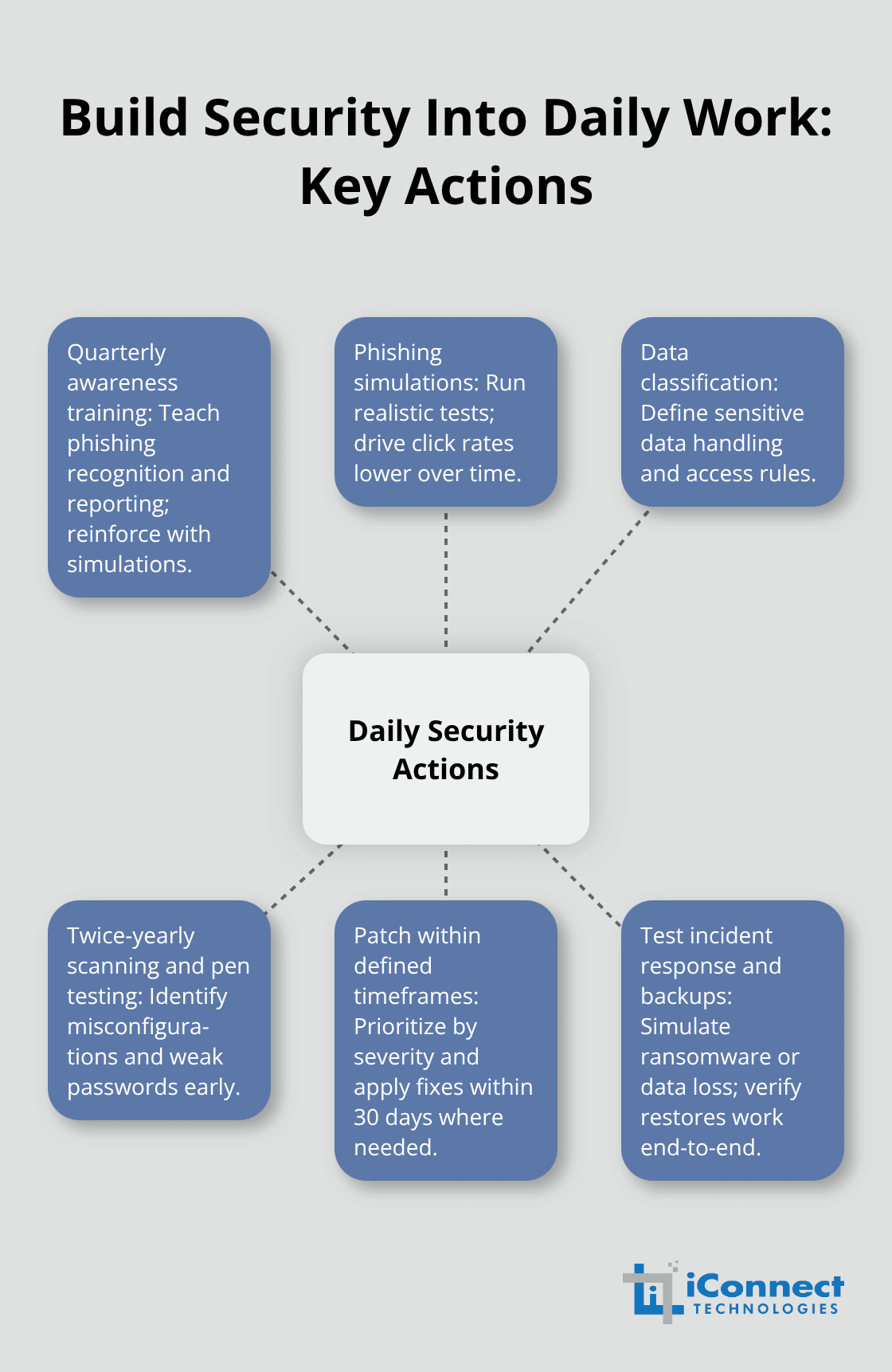
Organizations that patch within 30 days of a vulnerability disclosure reduce their breach risk dramatically compared to those that wait months.
Cloud environments require continuous assessment because misconfigurations in Azure, AWS, or other platforms often go unnoticed until attackers exploit them. Your MSP should provide regular compliance audits against frameworks like ISO 27001 or NIST CSF, translating technical findings into business language so leadership understands the risk and approves necessary investments. Test your incident response plan annually through simulations of data loss or ransomware attacks. These exercises reveal whether your backups restore correctly and whether your team can execute the response plan without chaos. Far too many organizations discover their backup strategy failed only after a real attack destroys their data.
Partner with Experts Who Own the Outcome
Selecting a managed IT provider focused on security fundamentally changes your defensive capabilities because you gain access to expertise, tools, and 24/7 monitoring that small businesses cannot build in-house affordably. The provider should offer vCISO consulting that translates your business goals into security strategy, ensuring investments protect what actually matters to your operations rather than following generic best practices. Certifications matter: your MSP should maintain SOC 2 Type II certification, demonstrating that their own security practices meet rigorous standards. Their team should include certified professionals like CISSP holders who understand both technical implementation and strategic governance.
The provider’s threat intelligence partnerships ensure your defenses stay current as attack techniques evolve, and their incident response capabilities mean trained professionals are available immediately when threats occur rather than your team scrambling to figure out what to do. The partnership approach works because one entity owns the entire outcome: when your firewall detects suspicious traffic and your endpoint protection identifies malware and your monitoring team investigates simultaneously, there is no finger-pointing or communication delays that extend your exposure window. This unified accountability accelerates your security maturity and transforms how your organization responds to threats.
Final Thoughts
Security-focused managed IT represents a fundamental shift in how small businesses protect their operations. Rather than treating security as an afterthought or a compliance burden, this approach embeds protection into every decision your organization makes, from network architecture to employee workflows. The stakes are clear: cyber threats continue accelerating, breach costs remain devastating, and regulatory requirements demand immediate action.
The long-term benefits extend far beyond avoiding incidents. When security receives priority from day one, your business gains operational resilience that supports growth without constant disruption. Your team spends less time managing disconnected tools and more time on strategic work that drives revenue, while your customers and partners gain confidence knowing their data receives genuine protection, not just checkbox compliance.
The path forward requires three concrete actions: conduct a comprehensive security risk assessment that identifies your current vulnerabilities and compliance gaps, evaluate whether your current IT approach can deliver the integrated monitoring and threat response that modern threats demand, and schedule a discovery session with a potential MSP partner to align your security strategy with business objectives and develop a realistic implementation roadmap for the next twelve months.